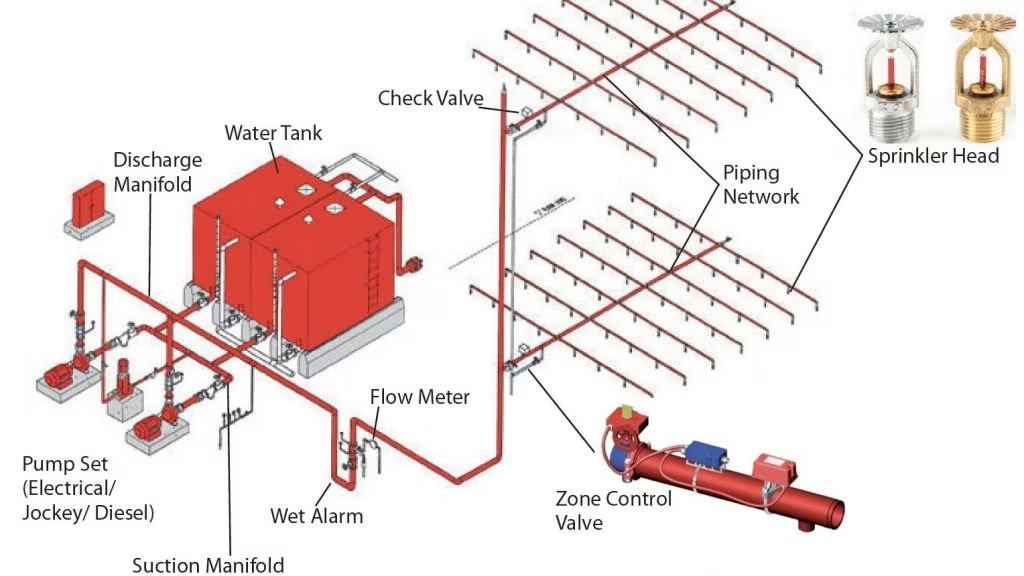
Thousands of fires occur across Turkey every year, and a significant proportion of them can be attributed to inadequate or poorly maintained fire suppression systems. The Regulation on Protection of Buildings Against Fire (Binaların Yangından Korunması Hakkında Yönetmelik) sets out in considerable detail which fire suppression systems must be installed in buildings, their technical specifications, and the maintenance requirements that must be met.
In this comprehensive guide, we cover every aspect of fire suppression systems: which systems are mandatory and in which buildings, the technical design criteria, how maintenance should be carried out, the 2025 updates, and your legal obligations. Drawing on 20 years of hands-on site experience, we share both the theory and the critical practical points that only come from being in the field.
1. Fire Suppression Systems: Core Principles and the Legal Framework
1.1. Legislation and Standards
In Turkey, fire suppression systems are regulated under Civil Defence Law No. 7126 and the Regulation on Protection of Buildings Against Fire (19 December 2007). Part 7 of the Regulation (Articles 90–100) sets out the design, installation, and operational requirements for fire suppression systems.
Where fire damage occurs as a result of non-compliance with the Regulation, liability falls — proportionate to their respective fault — on building owners, employers and their representatives, the architects and engineers responsible for design, application, and supervision, building inspection bodies, contractors, and manufacturers. This liability encompasses both civil and criminal sanctions.
The Standards Hierarchy:
When applying the Regulation, standards must be selected according to the following order of precedence:
- Turkish Standards (TS): First priority
- European Standards (EN): Where no TS standard exists
- International Standards: Where neither TS nor EN covers the subject (ISO, NFPA, FM, etc.)
| System Type | Primary Standard | Supplementary Standards | Application Area |
|---|---|---|---|
| Sprinkler System | TS EN 12845 | TS EN 671-3, TS 12845 | High-rise buildings, shopping centres, car parks |
| Fire Hose Reel | TS EN 671-1/2 | TS EN 671-3, TS 12266 | All buildings over 1,000 m² |
| Hydrant System | TS 3994 | TS EN 14339 | External areas and large structures |
| Foam System | TS EN 13565 | TS EN 1568 | Petrochemical plants, hangars, warehouses |
| Gaseous System | TS EN 15004 | TS ISO 14520 | Data centres, archives, museums |
| Dry Powder | TS EN 12416 | TS EN 615 | Electrical rooms, plant rooms |
1.2. System Design Principles
Article 90 of the Regulation establishes the fundamental principles for fire suppression systems:
Adequate Capacity: The system must have sufficient capacity to extinguish a fire that could occur within the building. This capacity is calculated with reference to the building's occupancy class, hazard category (LH, OH, HH), and the size of the protected area.
Reliability and Continuity: Throughout the economic life of the building, the system must be capable of operating — automatically or manually — at the required speed and performing its function. Continuity must be maintained against factors including power failure, frost risk, corrosion, and mechanical damage.
Compatibility: The type and quantity of fixed fire suppression equipment to be installed, and its positioning, must be determined with reference to both the building itself and the nature of the materials likely to be present within it.
Modern fire safety systems are designed to work in concert. Fire detection, smoke control, pressurisation, and suppression systems must all be designed together. This integration ensures that, in the event of a fire, every system operates in harmony and in synchronisation with the others.
1.3. The Critical 2025 Deadline: 31 December
The Regulation grants a transitional period during which deficiencies in existing buildings must be rectified. 31 December 2025 is the final day of that period. By this date:
- Fire hose reel systems must be installed in buildings larger than 1,000 m²
- Sprinkler systems must be completed in high-rise buildings (30.50 m and above)
- Automatic suppression systems must be operational in enclosed car parks (600 m² and above)
- Outstanding deficiencies in emergency lighting and fire detection systems must be addressed
If deficiencies are not remedied by 31 December 2025, the consequences are severe: occupancy certificates can be revoked, buildings may be refused a licence to operate, heavy administrative fines (₺100,000 and above) can be imposed, criminal liability arises where fire-related deaths or injuries result from the deficiency, and insurance claims may be refused.
2. Which Systems Are Mandatory, and in Which Buildings?
The Regulation prescribes different systems depending on a building's size, height, and intended use. The most common mandatory requirements are as follows:
2.1. Fire Hose Reel Obligation (Article 94)
A fire hose reel system (DN 25 hose system) is mandatory in the following buildings:
- All buildings with a structural height exceeding 28.5 m
- Factories, workshops, and warehouses with a total enclosed floor area exceeding 1,000 m²
- Accommodation, healthcare, assembly, and educational buildings exceeding 1,000 m²
- Enclosed car parks with a floor area exceeding 600 m²
- Boiler rooms with a thermal capacity exceeding 350 kW
Positioning Rules:
- Must be present on every floor and in each section separated by fire walls
- Maximum spacing of 30 metres between reels (45 m where a wet sprinkler system is installed)
- Should be positioned close to corridor exits and stairwell landings
- Must be clearly visible and readily accessible
Cost Guide: Installation of a fire hose reel system in a medium-sized building (3,000 m²) — including fire pump set, water storage tank, pipework, and cabinets — typically costs between ₺150,000 and ₺250,000.
2.2. Sprinkler System Obligation (Article 96)
Automatic sprinkler systems are mandatory in the following locations:
- Buildings with a structural height exceeding 30.50 m (all floors)
- Enclosed car parks (over 600 m²)
- Shopping centres and arcades
- Buildings containing atriums
- Warehouses and archives with a high fire load
- Industrial premises (depending on hazard category)
Practical Note: Sprinkler systems detect and extinguish fires automatically. Statistics show that fatalities in buildings fitted with sprinklers are reduced by as much as 87%.
Cost: A sprinkler system for a 3,000 m² shopping centre typically costs between ₺400,000 and ₺600,000.
2.3. Specialist Suppression System Obligation (Article 98)
In certain locations, water-based systems are not appropriate and specialist alternatives must be used:
Where mandatory: Data centres, server rooms, archives, museum storage areas, electrical transformer and generator rooms, telecommunications centres
Why not water: Water causes irreparable damage to electronic equipment; gaseous systems suppress fires without leaving any residue or causing secondary damage
Common types: FM-200, Novec 1230, Inergen (all safe for occupied areas), CO₂ (plant rooms only)
Cost: ₺80,000–₺150,000 for a medium-sized server room (50 m²)
3. Water-Based Suppression Systems: Technical Details and Calculations
Water-based suppression systems form the backbone of fire safety. Articles 91–97 of the Regulation provide detailed provisions covering water pressure, flow rates, storage tanks, fire pumps, fixed pipework, fire hose reels, hydrant systems, sprinkler systems, and fire brigade inlet connections.
3.1. Water Pressure and Flow Rate Requirements
Water pressure and flow rates directly determine the effectiveness of a fire suppression system. The Regulation and associated standards set out the following minimum values:
Fire Hose Reels (Article 94):
Semi-rigid hose reel (TS EN 671-1):
- Design flow rate: 100 litres/minute
- Design pressure at nozzle inlet: 400 kPa (4 bar)
- Maximum hose length: 30 metres
- If pressure exceeds 900 kPa, a pressure-reducing valve is mandatory
Flat hose reel (TS EN 671-2):
- Design flow rate: 400 litres/minute
- Design pressure at nozzle inlet: 400 kPa (4 bar)
- Maximum hose length: 20 metres
- If pressure exceeds 900 kPa, a pressure-reducing valve is mandatory
Hydrant System (Article 95):
- Design flow rate: Minimum 1,900 litres/minute (for a duration of 90 minutes)
- Pressure at hydrant outlet: 700 kPa (7 bar)
- Flow rate is increased according to the building's hazard category
- Note: In high-hazard areas, this may reach 3,000–5,000 l/min
Sprinkler System (Article 96):
- Head operating pressure: 50–100 kPa depending on the head's K-factor
- Design area: 9–21 m² per head (depending on hazard category)
- Flow density: 2.25–12.5 mm/min depending on hazard category (Annex 8/B)
Fire Pump Total Head Calculation
When selecting a fire pump, total head losses must be calculated. A safety factor of 10–15% additional pressure should be allowed for.
The most common mistake when selecting a fire pump is looking only at the static head. Pipe friction losses, outlet pressure requirements, and the safety margin must all be calculated properly. With 20 years of experience, we offer free hydraulic calculation support to ensure the correct pump selection and trouble-free operation throughout the system's lifetime.
3.2. Water Storage Tanks and Sources
The fire water tank is the lifeblood of the system. The Regulation bases tank capacity calculations on hazard category and reserve duration (Annex 8/A).
Example Tank Capacities:
- Low hazard (LH): Sprinkler + hose reel, 30-minute reserve = minimum 9 m³
- Ordinary hazard (OH-1): Sprinkler + hose reel, 60-minute reserve = minimum 54 m³
- High hazard (HH-2): Sprinkler + hose reel + hydrant, 90-minute reserve = minimum 180 m³
Worked Example:
5,000 m² shopping centre (Ordinary hazard OH-1):
- Sprinkler flow rate: 750 l/min (TS EN 12845 Annex 8/A)
- Fire hose reels: 200 l/min (2 simultaneous reels)
- Reserve duration: 60 minutes
- Calculation: (750 + 200) × 60 = 57,000 litres = 57 m³
- With 10% safety margin: 57 × 1.1 = 62.7 m³ ≈ 65 m³ tank recommended
Key considerations when designing a fire water tank: internal water temperature should be maintained between 4°C and 40°C (to prevent freezing and microbial growth); water quality must comply with TS 1051 drinking water standards; the tank material must be stainless or specially lined; drainage provision must allow for cleaning and maintenance; and a backup water supply connection (mains or borehole) should be incorporated.
Accepted Water Sources:
Under the Regulation, the following are accepted as fire water sources:
- The municipal mains supply (where pressure and flow are sufficient)
- Underground storage tanks (within or adjacent to the building)
- Above-ground tanks (roof tanks, tower tanks)
- Natural sources (lakes, rivers, boreholes — subject to special conditions and authorisation from the relevant authority)
3.3. Fire Pumps: Selection and Installation
The fire pump station is the heart of the system. Article 93 of the Regulation imposes strict requirements regarding power supply, backup arrangements, automation, and positioning of the pump station.
Pump Type Selection:
The most widely used type of fire pump. Available in horizontal or vertical shaft configurations.
- Advantages: Reliable, low maintenance requirements, high efficiency (65–80%)
- Disadvantages: Cannot run dry; requires priming if self-priming type is not used
- Application: The standard choice for most commercial and industrial buildings
- Standards: TS EN 12845, UL Listed or FM Approved pumps are preferred
3.4. Fire Hose Reel System
The fire hose reel system plays a critical role in first-response fire fighting. Article 94 of the Regulation defines both the buildings in which hose reels are mandatory and the technical requirements they must meet.
Technical Specifications:
| Cabinet Components | |
| Hose Type(mm) | DN 25 semi-rigid or fully rigid |
| Hose Length(m) | 30 (semi-rigid) / 20 (flat) |
| Nozzle Type | Adjustable (jet/spray/shut-off) |
| Valve | Ball valve DN 25 |
| Drum | Auto-rewind or fixed reel |
| Performance (TS EN 671-1) | |
| Design Flow Rate(l/min) | 100 |
| Pressure at Nozzle Inlet(kPa) | 400 |
| Maximum Pressure Limit(kPa) | 900 (pressure-reducing valve required above this) |
| Nozzle Range(m) | 10–12 |
| Standards | |
| Primary Standard | TS EN 671-1 (semi-rigid hose) |
| Alternative | TS EN 671-2 (flat hose, 400 l/min) |
| Maintenance Standard | TS EN 671-3 |
If your existing building does not have a fire hose reel system, it must be installed by 31 December 2025. Failure to comply can result in the revocation of the occupancy certificate and the imposition of administrative fines. The building owner and manager are both legally responsible.
3.5. Hydrant System
The hydrant system (Article 95) is designed for external intervention by the fire brigade and must be arranged so that fire engines can make a connection readily.
Hydrant Positioning Principles:
- Must be positioned to provide full perimeter coverage of the building
- Must be located at points easily accessible to fire appliances
- Should be positioned approximately 5–15 metres from the building
- Spacing between hydrants is determined by hazard category
| Hazard Category | Hydrant Spacing | Minimum Flow Rate | Outlet Pressure |
|---|---|---|---|
| Very High Risk | 50 m | 1,900+ l/min | 700 kPa |
| High Risk | 100 m | 1,900+ l/min | 700 kPa |
| Medium Risk | 125 m | 1,900 l/min | 700 kPa |
| Low Risk | 150 m | 1,900 l/min | 700 kPa |
Hydrant Pipework:
- A ring main (loop system) is preferred, providing feed from two directions
- Where a ring main is not installed, minimum pipe diameter must be 100 mm
- Pipe diameters must be determined by hydraulic calculation
- In frost-prone areas, a dry-barrel hydrant system may be used
3.6. Sprinkler System
The sprinkler system (Article 96) is the most effective form of automatic fire suppression available. The Regulation sets out both the areas in which sprinklers are mandatory and the design criteria that must be met.
Sprinkler Head Types and Selection:
Pipework is permanently charged with water; in a fire, the sprinkler head bulb breaks and water is discharged immediately.
- Advantages: Fast activation (0–10 seconds), simple system, low cost, most reliable type
- Disadvantages: Frost risk (below +4°C), occasional accidental discharge (rare)
- Application: All heated internal spaces — offices, residential, shopping centres, hospitals
- Operating Temperature: Environments between 4°C and 70°C
Sprinkler Design Parameters:
Design flow densities by hazard category are defined in Annex 8/B of the Regulation:
| Hazard Category | Flow Density | Design Area | Typical Application |
|---|---|---|---|
| LH (Light) | 2.25 mm/min | 84 m² | Offices, schools, hospital wards |
| OH-1 (Ordinary-1) | 5.0 mm/min | 72–144 m² | Car parks, Class I–II storage |
| OH-2 (Ordinary-2) | 5.0 mm/min | 144 m² | Libraries, workshops, textiles |
| OH-3 (Ordinary-3) | 5.0 mm/min | 180 m² | Timber processing, paper storage |
| HH-1 (High-1) | 12.5 mm/min | 260 m² | Plastics manufacturing, chemicals |
| HH-2 (High-2) | 12.5 mm/min | 372 m² | Paint factories, solvent storage |
Sprinkler Head Flow Rate Calculation
The flow rate of each sprinkler head is determined by its K-factor and operating pressure. The K-factor depends on the orifice diameter and is defined in the relevant standard.
Sprinkler Head Positioning:
- Standard mounting: 7.5–30 cm below the ceiling (TS EN 12845)
- Spacing between heads: 2.4–4.6 metres (depending on ceiling height and hazard category)
- Nearest head to a wall: Maximum 2.3 metres (half-spacing rule)
- Coverage area per head: 9–21 m² (maximum 12 m² for OH hazard category)
- Where ceiling pitch exceeds 10%, special calculation is required
Sprinkler heads must never be covered over, obstructed, or painted. Painted heads lose their thermal sensitivity and will either activate late in a fire or fail to activate at all. Stored goods, suspended ceilings, racking systems, and light fittings must not impede the protection afforded by any head. A minimum clearance of 45 cm must be maintained below each head.
3.7. Fire Brigade Inlet Connection (Siamese Connection)
The fire brigade inlet (Article 97) is essential, enabling fire crews to pump water into the system from outside the building.
Positioning Criteria:
- Must be located on or near the main entrance facade
- Between 0.75 m and 1.50 m above ground level
- At a point accessible to a fire appliance (within a maximum of 20 m)
- Must be clearly visible and accessible (red colour; mandatory signage)
- Direct connection to the system, fitted with a non-return (check) valve
Technical Specifications:
- 2.5 inch (DN 65) twin-port standard fire brigade coupling (Storz or Guillemin type)
- Non-return check valve
- Automatic drain system (frost protection)
- Isolation valve for testing and maintenance
- System identification plate (Sprinkler / Fire Hose Reel / Hydrant)
4. Foam, Gaseous, and Dry Powder Fixed Automatic Suppression Systems
Where water-based systems are not appropriate, specialist suppression systems are used. Article 98 of the Regulation specifies the areas in which such systems must be applied.
4.1. Foam Suppression Systems
Foam systems are effective against flammable liquid fires (Class B) and are covered in detail in Annexes 12 and 13 of the Regulation.
Application Areas:
- Fuel storage depots and service stations (mandatory)
- Petrochemical plants and refineries
- Aircraft hangars (AFFF — Aqueous Film Forming Foam mandatory)
- LPG filling and storage facilities
- Airport crash fire rescue (ARFF)
Foam Types and Characteristics:
| Foam Type | Expansion Ratio | Application | Standard |
|---|---|---|---|
| Low expansion | Up to 1:20 | Liquid fuel tanks, petrol | TS EN 1568-3 |
| Medium expansion | 20:200 | Hangars, refineries, paint stores | TS EN 1568-3 |
| High expansion | 200:1000 | Warehouses, basements, enclosed spaces | TS EN 1568-4 |
| AFFF (Film-forming) | Spray/foam | Petroleum products, aviation | TS EN 1568-3 |
Foam Concentration:
- For hydrocarbons: 3% or 6% concentrate
- For polar solvents (alcohol, etc.): 3% AR-AFFF (Alcohol Resistant)
4.2. Gaseous Suppression Systems
Gaseous systems protect valuable equipment that would be damaged by water. The Regulation recommends gaseous systems for areas containing electronic equipment.
Application Areas:
- Data centres and server rooms (considered mandatory)
- Telecommunications centres
- Archive and museum storage
- Electrical transformer and generator rooms
- Laboratories and clean rooms
Comparison of Suppression Gases:
| FM-200 | Novec 1230 | Inergen | CO₂ | |
|---|---|---|---|---|
| Chemical Properties | ||||
| Chemical Formula | C₃HF₇ | C₆F₁₂O | N₂/Ar/CO₂ | CO₂ |
| Ozone Depletion Potential | 0 | 0 | 0 | 0 |
| Global Warming Potential (GWP) | 675 | 1 | 0 | 1 |
| Human Safety (NOAEL) | 9% | 10% | 43% | Hazardous >5% |
| System Characteristics | ||||
| Design Concentration(%) | 7–8% | 4–6% | 35–40% | 34–50% |
| Discharge Time | 10 sec | 10 sec | 60 sec | 60 sec |
| Storage Pressure(bar) | 25–42 | 25–42 | 200–300 | 52–150 |
| Hold Time | 10 min | 10 min | 10 min | 20 min |
| Advantages / Disadvantages | ||||
| Electrical Conductivity | None | None | None | None |
| Residue | None | None | None | None |
| Visibility | Unaffected | Unaffected | Unaffected | Limited (mist) |
| Cost | Medium | High | Low | Low |
CO₂ systems can be lethal to people in total flooding applications (concentrations above 5% are dangerous). A mandatory 30-second delayed discharge, audible and visual pre-warning (minimum 20 seconds), an abort button, and automatic post-discharge ventilation are all compulsory. In areas where people may be present, locally applied CO₂ or alternative inert gas agents should be preferred. The Regulation prescribes additional safety measures for CO₂ system installations.
Gaseous System Design Steps:
- 1
Volume and Leakage Calculation
The net volume of the protected space is calculated, leakage through doors and windows is assessed, and a fan/air conditioning shutdown system is designed.
- 2
Determining Gas Quantity
The required quantity of gas is calculated based on the design concentration, and a safety margin of 10–20% is added.
- 3
Cylinder Count and Placement
The number of gas cylinders and their operating pressures are determined, and the storage room is designed accordingly.
- 4
Nozzle Design
Gas discharge nozzles are positioned throughout the protected space and the discharge time (10–60 seconds) is optimised.
- 5
Detection and Control Integration
A dual detection system (cross-zone), delayed discharge, abort button, and pre-alarm system are installed.
- 6
Ventilation and Safety
Post-discharge automatic ventilation, warning signage, personnel training, and emergency procedures are all established.
4.3. Dry Powder Suppression Systems
Dry chemical powder systems (Article 98) are used for fires involving electrical equipment and in specialist applications.
Application Areas:
- Transformer rooms
- Electrical switchboards and switchgear
- Motor control centres (MCCs)
- Industrial ovens and dryers
- Combustible metal processing areas
Dry Powder Types:
- ABC Powder (Monoammonium phosphate): Class A-B-C fires; universal application; most widely used
- BC Powder (Sodium bicarbonate / Potassium bicarbonate): Class B-C fires; particularly suited to electrical fires
- D Powder (Specialist chemical powder): Metal fires (magnesium, sodium, potassium, titanium)
Advantages and Disadvantages:
✅ Advantages:
- Non-conductive
- Immediate knockdown (within seconds)
- Low system cost
- Easy to maintain
❌ Disadvantages:
- Contaminates the environment (white powder residue)
- Not suitable for sensitive equipment
- Cleaning is difficult and expensive
- Reduces visibility to zero
- Risk of corrosion where moisture is present
5. Portable Fire Extinguishers
Portable fire extinguishers are the first-response tool in any fire safety strategy. Article 99 of the Regulation governs extinguisher types, capacities, and positioning requirements.
5.1. Extinguisher Types and Capacities
| Extinguisher Type | Fire Class | Minimum Capacity | Coverage Area | Typical Location |
|---|---|---|---|---|
| Dry Powder (ABC) | A-B-C | 6 kg | 200 m² | General purpose — offices, residential |
| Carbon Dioxide (CO₂) | B-C | 5 kg | Special areas | Electrical rooms, laboratories |
| Foam (AFFF) | A-B | 6 l | 200 m² | Kitchens, garages, workshops |
| Wet Chemical (Type K) | F (cooking oils) | 6 l | Kitchen area | Commercial kitchens, restaurants |
| Water-based | A | 9 l | 200 m² | Offices, paper storage |
| Halocarbon (Clean Agent) | B-C | 2–6 kg | Sensitive areas | Server rooms, medical equipment |
5.2. Extinguisher Positioning Rules
Positioning requirements under Article 99 of the Regulation:
General Principles:
- Must be positioned in clearly visible and readily accessible locations
- Wall-mounted between 90 cm and 120 cm above floor level
- Along escape routes and close to exits
- Mandatory signage required (TS 11743 photoluminescent sign, minimum 150×150 mm)
- Operating instructions must be in Turkish and clearly legible
- Must be fixed to the wall, not left standing on the floor
Spacing Rules (Travel Distance):
- Class A fire risk: Maximum 25 metres
- Class B fire risk: Maximum 15 metres
- Special hazard areas: 10 metres or less
Area Calculation:
- Minimum 1 ABC dry powder extinguisher (6 kg) per 200 m² of floor area
- Additional extinguishers at specific hazard points (switchboards, boiler rooms, kitchens)
- 1
Determine the Hazard Class
Identify the Class A, B, C, D, or F fire risks associated with the building's intended use. More than one class may apply.
- 2
Calculate Area and Number of Units
Position a minimum of one ABC dry powder extinguisher (6 kg) per 200 m². Account for floor level changes and partition walls.
- 3
Identify Special Hazard Points
Add appropriately rated specialist extinguishers at switchboards, boiler rooms, kitchens, and generator sets.
- 4
Prepare a Positioning Plan
Mark extinguisher locations on the floor plan, verify travel distances, and ensure positions are along escape routes.
- 5
Signage and Training
Fit photoluminescent signs, deliver basic fire safety training to occupants, and conduct an annual fire drill.
Offices and Administrative Buildings: ABC dry powder 6 kg for general areas (per 200 m²); CO₂ 5 kg additionally for electrical rooms. Commercial Kitchens: Wet chemical (Type K) 6 litre under the extraction canopy is mandatory; ABC dry powder for general areas. Data Centres: CO₂ 5 kg or halocarbon only — powder is strictly prohibited (equipment damage). Petrol Stations: ABC dry powder 12 kg plus foam 50 litre (wheeled) mandatory. Electrical Transformers: CO₂ 45 kg (wheeled) or a fixed automatic system is preferred.
6. Periodic Testing, Maintenance, and Inspection
The continued effectiveness of fire suppression systems depends entirely on regular testing and maintenance. Article 100 of the Regulation and Article 85 of Part 5 set out the mandatory periodic inspection requirements in detail.
6.1. Periodic Testing and Maintenance Responsibilities
Legal Responsibility:
Periodic inspection, testing, and maintenance of systems is the responsibility of the building owner, manager, or the building's designated responsible officer to whom that responsibility has been formally delegated in writing. This responsibility cannot be transferred informally and must not be neglected.
Maintenance and Testing Requirements:
Maintenance and testing must be carried out at the intervals specified in the relevant standards, by trained personnel or by firms providing this service professionally. Maintenance records must be retained for a minimum of five years.
6.2. Periodic Inspection Schedule by System
| System / Equipment | Weekly | Monthly | Quarterly | 6-Monthly | Annual |
|---|---|---|---|---|---|
| Fire Pump | Visual check | Test run (10 min) | – | Load test | Full service + performance test |
| Fire Hose Reel | – | Visual check | – | Pressure test | Hose replacement (every 5 years) |
| Sprinkler System | – | Visual + alarm check | Valve test | – | Full system test + hydraulic check |
| Gaseous System | – | Control panel check | – | Gas level + pressure check | Discharge test (alternate years) |
| Fire Detection | – | Detector test (10%) | – | – | Full system test |
| Portable Extinguishers | – | – | – | – | Label check + recharge |
| Emergency Lighting | – | Lamp test (30 min) | – | – | Battery replacement (every 3–5 years) |
Under recent changes to the Regulation, fire safety reports have become mandatory. Buildings of a certain size and occupancy type (high-rise buildings, shopping centres, hospitals, etc.) must be inspected annually or biennially by a qualified basic or advanced fire safety specialist. The inspection report must be submitted to the licensing authority and the fire brigade. Buildings without a valid report risk revocation of their occupancy certificate and administrative fines.
Annual Maintenance Cost Guide:
- Full fire pump service: ₺8,000–₺15,000
- Sprinkler system test and report: ₺12,000–₺25,000
- Fire hose reel periodic maintenance: ₺3,000–₺6,000 (for 10 reels)
- Portable extinguisher recharge: ₺150–₺300 per unit
- Annual gaseous system inspection: ₺5,000–₺10,000
An annual maintenance contract bundles all periodic inspections, test reports, emergency call-out response, and spare parts support into a single arrangement. It typically delivers both a cost saving of 20–30% and the assurance of ongoing legal compliance. With 20 years of experience, we provide comprehensive maintenance services nationwide.
6.3. Acceptance Testing and Commissioning
Newly installed systems, or systems that have undergone major remedial work, must pass a comprehensive acceptance test before being brought into service.
Sprinkler System Acceptance Test Steps:
- 1
Visual Inspection and Documentation
Are all pipework, valves, heads, and accessories documented as compliant with TS EN 12845? TSE certificates are checked and installation workmanship is assessed against the standards.
- 2
Pressure and Tightness Test (Hydrostatic Test)
The system is subjected to a hydrostatic test at 200 psi (14 bar) for a minimum of 2 hours. No leakage is acceptable. All pipe joints, weld points, and flanges are individually checked.
- 3
Flow and Discharge Test
The system is operated at its design flow rate; pressure and flow rate are measured at the most remote and highest head location and compared against the hydraulic calculations.
- 4
Alarm and Control Tests
The flow switch, pressure switch, alarm bell, indicators, gauges, and all automatic controls are tested. Signal transmission to the fire control panel is verified.
- 5
Pump Performance Test
The fire pump is operated and a capacity-head curve (Q-H curve) is recorded; the generator and diesel pump are brought online; and automatic start-up is tested.
- 6
Integration and Simulation
Integration with the fire detection system is tested; scenario-based simulation is carried out (e.g., smoke detector activation, sprinkler head opening).
- 7
Documentation and Training
Test results are formally reported; operators are trained in system use and maintenance; as-built drawings are handed over; and a maintenance manual is prepared.
6.4. Maintenance Log and Record-Keeping
A separate maintenance log must be kept for each fire suppression system. The log should contain:
- System technical specifications and date of installation
- Periodic maintenance dates and work carried out
- Test results and measured values (pressure, flow rate, current, etc.)
- Fault records and the actions taken
- Component replacements and materials used (must carry TSE certification)
- Details and signature of the maintenance firm and personnel
- Next maintenance date and list of scheduled work
7. Frequently Asked Questions (Technical Answers)
8. Conclusion: Technical Expertise and Legal Compliance
Part 7 of the Regulation on Protection of Buildings Against Fire establishes the technical foundation for fire suppression systems in Turkey. Every detail — from water-based suppression systems through to specialist gaseous systems, from portable extinguishers to periodic maintenance — has been carefully regulated in the interests of protecting lives and property.
Implementing these regulatory requirements is not simply a legal formality; it is a process that demands genuine engineering expertise. Every stage — from hydraulic pressure calculations and sprinkler head layout to fire pump selection and smoke control system integration — calls for experience and deep technical knowledge.
The regulations currently in force for 2025 impose concrete deadlines for remedying deficiencies in existing buildings. The date of 31 December 2025 is a critical milestone for many building owners and managers. After this date, buildings with outstanding deficiencies face revocation of their occupancy certificate, refusal of a licence to operate, and severe administrative penalties.
Compliance with the standards hierarchy is an absolute requirement in system design. Core standards such as TS EN 12845, TS EN 671, and TS 3994 define the performance criteria for fire suppression systems. Systems that do not comply with these standards may prove inadequate in a real fire, with potentially fatal consequences.
Periodic testing and maintenance guarantees the operational effectiveness of installed systems throughout their service life. Everything from weekly visual checks to annual full system tests must be recorded in the maintenance log and properly documented. The legal and criminal consequences of neglecting maintenance far outweigh the financial costs of carrying it out.
Fire safety is not a matter that can be deferred or overlooked. With professional design, compliant installation, and regular maintenance, the fire safety of any building can be assured. Working with experienced engineering teams, contractors who know the standards inside out, and technically trained personnel who receive ongoing development is the surest way to guarantee both legal compliance and the effectiveness of the system in practice.
With 20 years of experience, we provide fire suppression system design, installation, commissioning, periodic maintenance, and legal compliance consultancy services nationwide. With more than 500 reference projects and a 100% client satisfaction record, we are here when you need us.